

EU Orders To EU Customers
Stopped Costing More To Fulfil
Replacement of a single GB fulfilment origin serving all EU demand with a two-node UK and Netherlands model, selected through a vendor-neutral 3PL RFP and integrated across the order layer, storefront and returns platform.
80
%
EU Orders Covered By The EU Node
1
New EU Fulfilment Partner
From 4 → 0
Customs-Controlled Movements Per Returned And Resold EU Pair
Client Profile
D2C Footwear Brand
~£24m net revenue · ~25k orders/m shipped, ~38k at peak.
Average Basket Value ~£115, with returns at ~30%.
Single UK 3PL fulfilling all demand from one GB site.
1/3 of orders ship to EU markets, led by Germany, France and the Netherlands.
Product manufactured in Portugal and Italy.
The Challenge
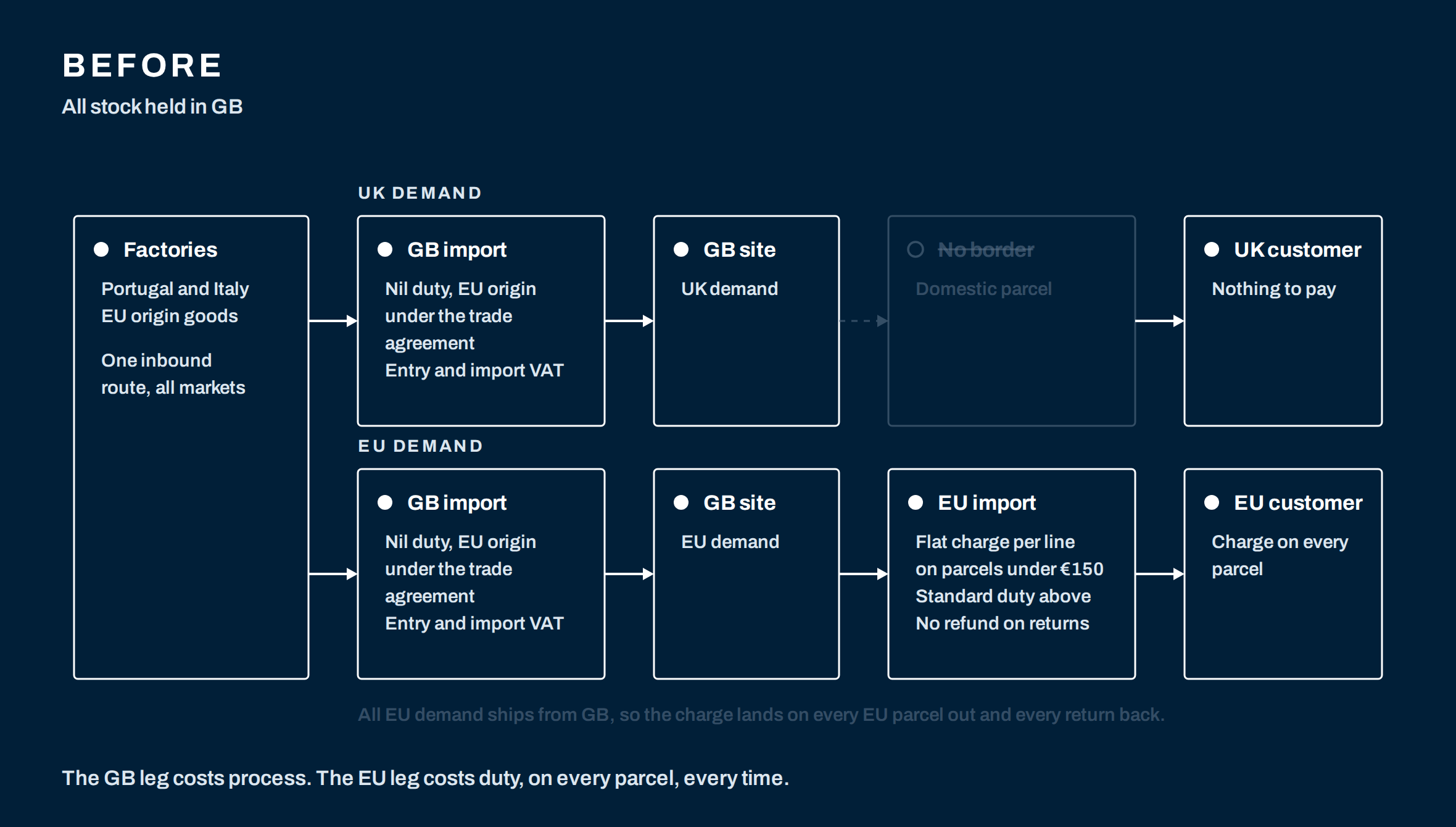
Every order was picked and despatched from one GB site. Stock manufactured in Portugal and Italy entered GB under the applicable preferential treatment where the required origin evidence was available. It was then exported back to EU customers as an individual cross-border consignment, with an import declaration on every order. Every EU return followed the same route in reverse, back to GB for inspection and restock, before being exported again if it was resold to another EU customer.
From 1 July 2026, the EU replaced the €150 duty-free threshold with a temporary €3 charge per tariff-classified item on qualifying low-value imports. Higher-value orders moved into normal tariff treatment, while the temporary charge is not automatically repaid on returns and is expected to be replaced by standard tariff treatment from July 2028.
The business was therefore moving EU-manufactured product out of the EU and importing it back into the same market, creating repeated customs movements and duty exposure across approximately a third of its volume. The cost was due to increase under the published regulatory timetable, but the routing itself was a legacy of where the business had grown from rather than a deliberate supply-chain decision.
Why EQ50 DIGITAL
A node decision falls across three kinds of supplier.
A broker rules on origin and classification but does not select warehouses. A consultancy builds the business case but does not deliver the integration. A systems integrator connects a second node without holding a position on whether it should exist.
EQ50 DIGITAL was appointed across all four stages: modelling, selection, integration and cutover.
Those stages are dependent. The exposure had to be sized at line level before the investment could be justified, the node tested against lighter alternatives before capital was committed, and the provider selected on operating fit before anything was built. A single appointment kept the reasoning intact from the model through to go-live.
EQ50 DIGITAL owned the business case, the selection, the integration and the cutover, and handed over an operating model the client runs itself.
The EQ50 DIGITAL Approach
01
Clarify the business priorities
A session with Finance, Operations and Ecommerce set the order: remove the structural duty cost on EU volume, protect UK service through the change, and avoid two large operational changes in one year.
The third priority shaped the programme. The UK 3PL contract was near review and was held back deliberately, so an EU node was not built on top of a UK transition.
The returns proposition was deferred on the same logic, since a node changes where returns go, not how customers return them.
02
Diagnose and scope
Twelve months of order and returns data was cut by market, by basket value either side of the €150 threshold and by product classification, so the exposure was sized at line level rather than at an average, then run forward to the end of the interim window. That set the programme’s timing: the node had to be live and holding EU volume before standard duty applies to the whole book.
Lighter options were tested first and rejected on stated grounds. Better cross-border rates and a consolidated linehaul reduce freight but leave the customs event and the duty in place. A European returns hub fixes the reverse leg only. Shipping direct from the factories was not workable at single-parcel scale.
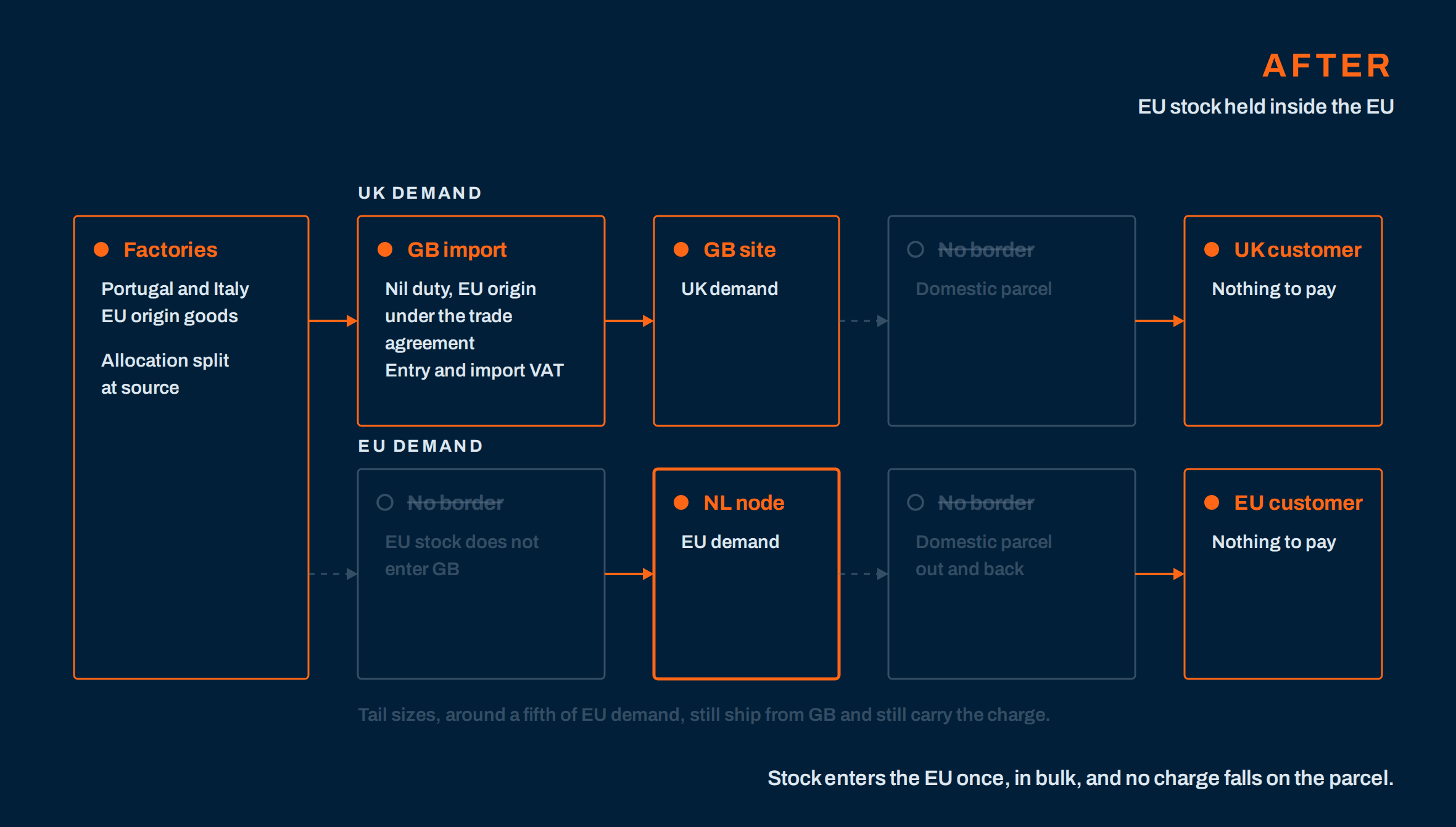
Size-curve modelling established that a node holding core styles and core sizes could serve around four fifths of EU demand, which set the allocation and kept the GB to EU lane open for the tail.
03
Design the solution
An RFP went to five EU providers and a shortlist of three, scored on footwear handling and size-level pick accuracy, returns inspection and in-market restock, pooled domestic carrier depth in the target markets, integration maturity against the order layer, and three-year cost including inbound handling and per-order fees.
The Netherlands was selected over cheaper central European options on proximity to the demand centre and to returns volume, accepting a higher operating cost per order.
Routing rules serve an order whole from one node wherever possible, splitting only where a tail size forces it. Inbound flow was redirected so the EU allocation ships from the factories to the node and never enters GB.
04
Deliver the change
Integration Readiness came first: what the storefront exposed for multi-location inventory and per-market delivery options, what the order layer could do with routing rules, and whether the returns platform supported a second return address. That set the pattern, platform-native for inventory and routing, direct API for the node’s despatch and tracking events, configuration only on the returns platform.
Built to it: inventory sync per node, routing rules, and despatch and tracking events feeding one customer-facing journey regardless of which node served the order, with delivery options and dates set per market against the serving node. Advance inbound and returns manifests flow to the node’s goods-in, which is visibility into the 3PL’s system rather than a change to how the 3PL processes it.
Cutover ran market by market in the two months after peak. The Netherlands and Germany went first with the GB site holding full fallback capability, and France, Ireland, Italy and Spain followed once the first two markets held for a full month.
Key Decisions & Trade-Offs
The node was justified on the duty step-up, not on delivery speed.
Faster EU delivery was the easiest case to make internally and the weakest basis for the investment, because the existing cross-border road service was acceptable to customers. The figure that carried the decision was the duty and per-line exposure across the whole EU book, modelled through to the end of the interim rate.
That ties the business case to a regulatory position that can move. It was built to pay back at the current rate, so a delay to the step-up slows the return rather than removing it.
The EU carrier contracts stayed with the 3PL.
The brand had no EU shipping history and no in-market volume to negotiate against. At this scale the provider’s pooled volume beat anything achievable directly, so carrier depth per market was scored inside the RFP rather than pulled out as a separate negotiation.
The cost is ownership. The brand does not hold those contracts, the rate detail or the direct carrier relationship, and sees the provider’s view of performance. Bringing them in-house was deferred until the node’s own volume justifies it.
Core sizes to the node, the tail from GB.
Duplicating the full size curve across two nodes was the largest single line in the model and the quickest route to stranded stock in the wrong country. Core styles and core sizes covered around four fifths of EU demand on twelve months of data.
The remaining fifth, around 20,000 parcels a year, still ships cross-border from GB, so the customs event was not removed from the whole book, and a small share of orders split across two nodes. The alternative was a much larger inventory commitment made against sell-through data that did not yet exist.
The Outcomes
~80%
Share of EU orders served in-market at go-live, set by the core styles and sizes allocated to the node.
4 → 0
Customs events in the life of a pair that is bought in the EU, returned and resold. Stock now arrives from the factories into the node, ships domestically, comes back domestically and is resold from the same shelf.
−2 days
Median delivery time on in-market EU orders in the first full quarter after go-live, against the pre-engagement cross-border baseline.
The Handover
The client owns the provider relationship and its performance framework, the allocation model that decides what sits at each node, and the routing rules that decide which node serves an order.
Handed over with it was an allocation review tied to sell-through, so the node’s range can widen without re-engagement, integration documentation covering both nodes, and the modelled duty position alongside the broker’s origin confirmation, so the case for the remaining GB to EU tail can be retested when the interim rate ends.