

From One Way To Return
To Six
Replacement of a single in-box label and a manual customer-service workaround for a D2C womenswear brand, with a specialist returns platform offering six self-serve methods, integrated across Shopify Plus and two warehouses.
-62
%
Returns-Related CS Contacts
1
New Returns Management System
From 1 → 6
Customer Return Methods
Client Profile
D2C Contemporary Womenswear Brand
~£40m revenue · ~55k orders/m at peak
Own D2C storefront.
Ships to UK & EU.
Two 3PL (UK + NL).
Single carrier in-box returns.
The Challenge
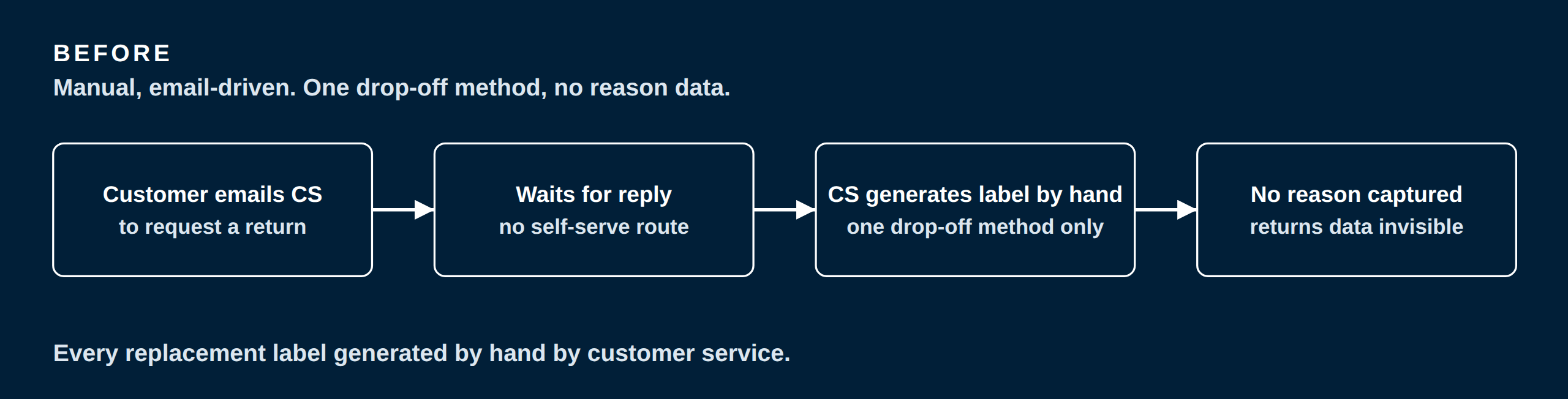
Every parcel shipped with a pre-printed carrier returns label in the box, drop-off only. If a customer lost the label the only route was to email customer service, who would generate a replacement label by hand and sent it back by email.
The single returns option suppressed return convenience in a category where easy returns drive repeat purchase.
The in-box label carried a quiet cost since the brand paid to include a label on every order while only a portion were ever used.
Why EQ50 DIGITAL
The platform brings the carrier network, locker access and QR capability.
EQ50 DIGITAL helps the client choose the returns platform and makes it work cleanly against Shopify Plus and both warehouses.
The EQ50 DIGITAL Approach
01
Clarify the business priorities
A working session with Ecommerce, CS and Operations set the order: widen customer return options, remove manual label handling, capture clean reason data.
Both warehouses stayed in scope so the solution served UK and EU consistently.
02
Diagnose and scope
EQ50 DIGITAL mapped the returns flow across both warehouses and pulled three months of data to size the problem by market, reason and category, including the volume of manual replacement-label requests hitting CS.
That fed a selection across three platforms, scored on carrier and locker breadth, multi-warehouse handling, QR and label-on-demand capability, Shopify Plus integration maturity and three-year cost.
03
Design the solution
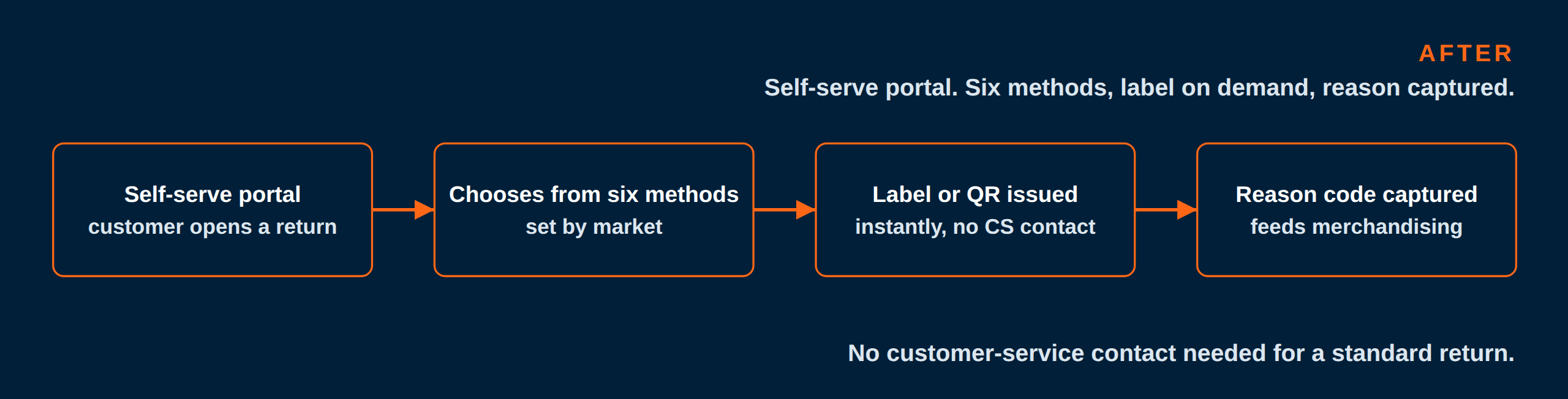
The selected platform was configured to offer the existing carrier drop-off, parcel lockers, additional carriers, further drop-off points, printer-free QR codes and booked home collections, with availability set by market.
The cost saving came from the platform’s pre-negotiated carrier rates and a wider mix of cheaper-to-serve methods, which brought the blended cost per return below the old single in-box label, a premium route that had been applied to every order.
The methods that cost materially more to run, such as booked home collection, carry a charge to the customer.
The in-box label was removed in favour of label and QR generation through the platform, issued the moment a customer opens a return.
04
Deliver the change
The platform was integrated to Shopify Plus and both warehouses, with advance returns manifests flowing to goods-in so each site knew what was arriving and why.
CS was retrained around exception handling rather than label generation.
Key Decisions & Trade-Offs
Platform selection on the right axis.
The two contenders were close on customer-facing features, so they were scored on what decides success after launch: carrier and locker depth in the UK and relevant EU markets, integration cleanliness against Shopify Plus and the two warehouse systems, and three-year cost including per-return fees.
Removing the in-box label.
Moving to label-on-demand saved the cost of a label on every order and widened choice, but added one step at return time and depended on the platform being reliable from day one. QR codes covered customers without a printer; the dual-run covered the rest.
Free methods, with a charge on the costliest to serve.
Cheaper-to-serve methods like drop-off and lockers were free; the methods that cost materially more to run, such as booked home collection, carried a charge.
Demand settles onto the efficient options without forcing a speed-versus-price choice, and the customer pays only for the convenience they choose.