

A Delivery Operation
Built Entirely On One Carrier
And One Direct Integration.
Running a carrier RFP, integrating a carrier management system, rebuilding the checkout and outbound warehouse processes around it, and moving a D2C luxury fashion brand onto a managed multi-carrier network.
-11
%
Cost per shipment
1
Carrier Management System
From 1 → 2
Carriers
Client Profile
D2C Luxury Fashion
£40 to 60m revenue · ~480k orders/yr
Own D2C storefront.
Ships to UK, EU & US.
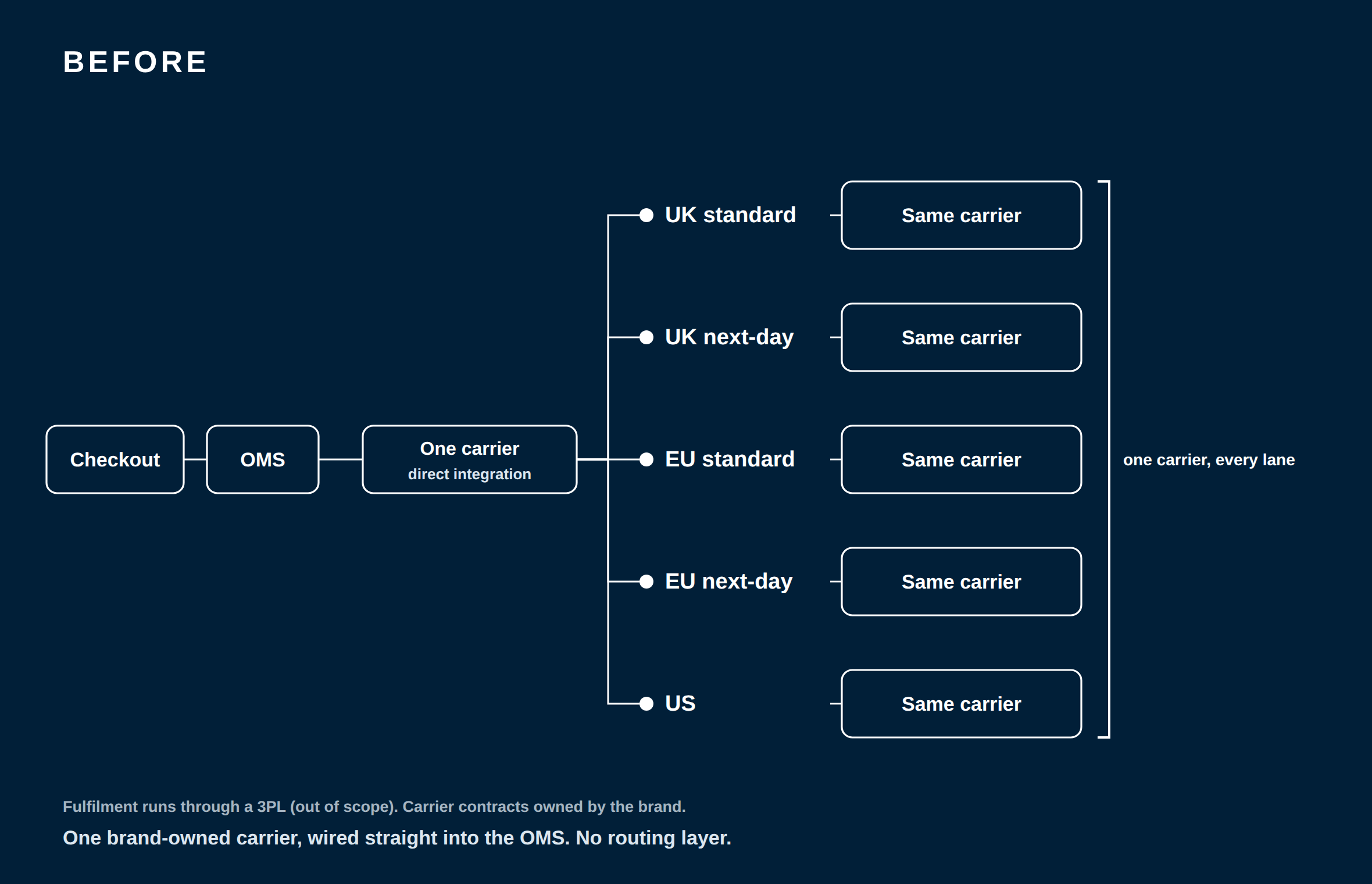
Single express carrier across all lanes, no carrier-management layer.
UK 3PL fulfilment.
The Challenge
Express on commodity volume. The carrier fitted the international lanes, where air is mandatory to the US and express is justified on EU next-day. But the same economics applied to UK domestic, 60% of parcels, where most orders needed a standard service that costs materially less.
No way to route by lane. Without a management layer, the brand could not move commodity UK volume to a different carrier without losing the international service that worked.
No leverage, no fallback. One contract across every lane meant nothing to negotiate with at renewal and no continuity if the carrier slipped, with the small US lane banding poorly on its own.
Why EQ50 DIGITAL
The carrier negotiation, system selection, integration to order management and ERP, checkout changes and operational changes were one programme with hard dependencies between them.
The work needed a single partner to hold those together.
EQ50 DIGITAL was appointed as a vendor-neutral selector and integrator. The RFP and the system selection were run on fit, total cost and operational reality rather than on any pre-existing supplier relationship.
That neutrality mattered most at the point where a brand is easiest to oversell: choosing the system that everything else would depend on.
The EQ50 DIGITAL Approach
01
Clarify the business priorities
EQ50 DIGITAL agreed the commercial priorities with the board: protect margin against the renewal, keep the carrier where it earned its rate, move commodity volume onto a service priced for it, and add a management layer so the brand could route, price and re-tender lane by lane.
02
Diagnose and scope
Each lane assessed on what it needed.
UK standard called for a cost-appropriate carrier (which one, left to the RFP); UK premium kept a next-day option.
International was the opposite case: the carrier was genuinely strong on EU express and US air, so the question was how to price it, not whether to replace it.
With EU and US each modest, contracting them together would band the small US lane off the larger EU volume.
03
Design the solution
The RFP ran as a structured tender on fit, total cost and operational reality.
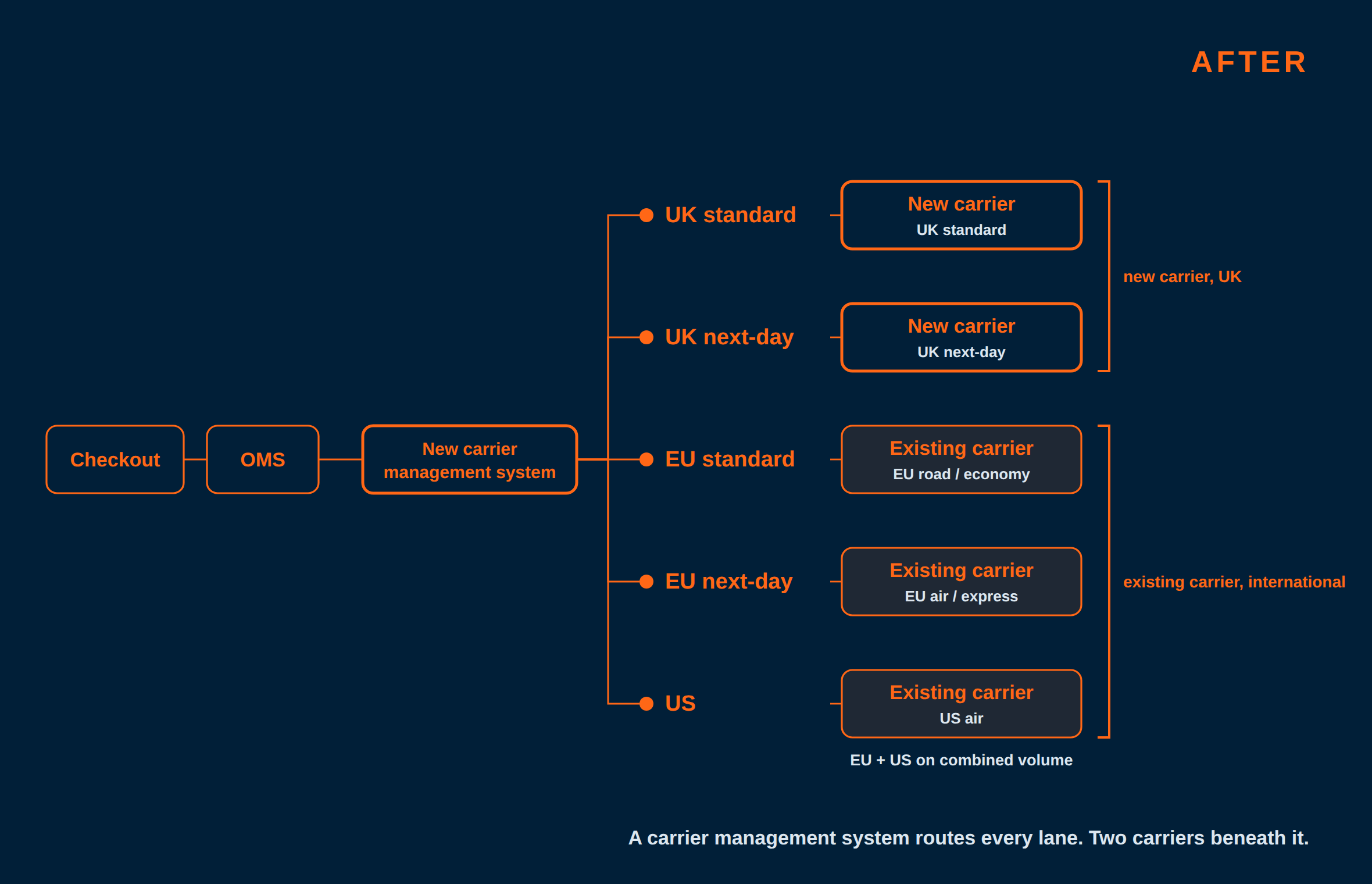
It returned the UK economy carrier for standard domestic and confirmed that keeping and renegotiating the existing carrier beat moving international to a new one.
The result: a two-carrier network, with the existing carrier kept in the carrier management system as a UK fallback, the CMS (also chosen by an RFP) holding the routing logic, and checkout options redrawn onto real services with delivered-duty-paid kept on international.
04
Deliver the change
Gated phases: system integration first, then carrier enablement, then 3PL process changes and checkout, then a controlled cutover. Each gate locked before the next built on it.
Key Decisions & Trade-Offs
Move all UK volume to a new domestic carrier, chosen by RFP
All UK volume, both tiers, moved to a new carrier selected on rate, coverage and fit through the RFP. The existing carrier came off UK entirely, but was kept in the CMS as a configured fallback, so UK no longer depends on a single carrier without a second integration to stand it up.
Trade-off: UK runs primarily on one new carrier rather than a permanent two-carrier split, accepted because the express integrator’s UK rates could not be justified and the CMS fallback preserves continuity. The new carrier had to prove its next-day service against live volume before the cutover committed to it.
Keep the existing carrier on EU and US, renegotiated on volume.
The RFP tested international on the open market and confirmed the existing carrier, strong on EU express and US air, was the one to keep. Renegotiated as one combined-volume agreement, so the small US lane priced off the larger EU volume.
Trade-off: pricing US alone would have banded worse, and chasing a rate with a new carrier would have risked lanes that already worked. The CMS gave the brand a credible alternative to walk to, which is what made the renegotiation bite.
Hold international steady this cycle and plan an RFP for the next renewal.
One new carrier and a warehouse and checkout rebuild were already in flight. Stacking a second carrier change on top would have piled on disruption the phased approach was built to avoid, so international was held steady, with a dedicated RFP timed to the next renewal.
Trade-off: international runs on a single carrier in the meantime, with no immediate fallback, recorded as a known exposure. The CMS is configured so a second carrier can be added later without re-engineering.
The Outcomes
-11%
Cost per Parcel
Blended cost per parcel fell by 11%, driven by the renegotiated UK rates and the combined international agreement, against an incumbent renewal that would have raised it.
Scalability
The business moved from single-carrier dependency to a managed multi-carrier network that can be re-tendered, rerouted and scaled.
Paperless Trade
Customs documentation moved off the manual process, generated in the carrier management system for EU DDP and US shipments.
E2E Delivery
Checkout options mapped onto real services and operational processes, with named next-day and optimised order cut-offs aligned with the 3PL capability.
The Handover
Carrier contracts and rate cards
Carrier management system configuration and routing logic
Checkout-to-service mapping and warehouse process changes
Per-carrier escalation routes and customer-service materials
The network was built to run and change without depending on EQ50 DIGITAL: routing adjusted, carriers re-tendered, and new lanes or services added through the system rather than a fresh integration each time.
The international RFP sits on the client’s own roadmap, timed to the next renewal, ready to run without re-engineering.
EQ50 DIGITAL stayed available on a defined support basis through the first peak, at the client’s option. The brand runs the network on its own terms.