

A First D2C Storefront,
Alongside The Marketplace
Build of a first owned D2C storefront for a pet consumables brand on Shopify, alongside a running marketplace channel.
2
Order Profiles On One Stock Pool
1
Owned D2C Storefront, Live
Marketplace first
Allocation Priority Under Contention
Client Profile
Pet Consumables Brand
~£5m revenue · ~12k orders/m
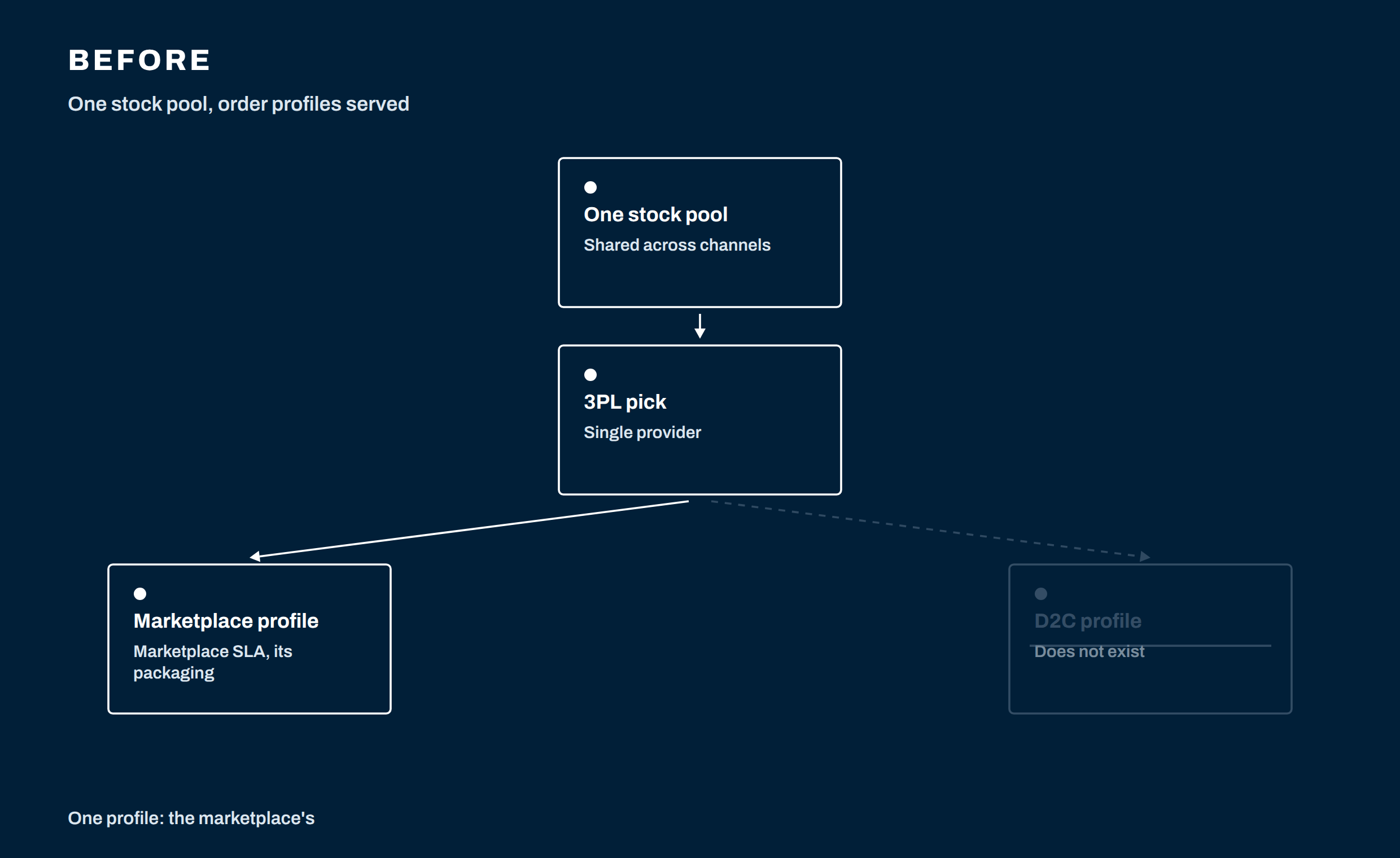
Marketplace channel only, no owned storefront.
Single 3PL, UK, configured for one order profile.
Around £35 AOV on light consumables, high repeat purchase.
The Challenge
Every order came through one marketplace so the fee structures plus fulfilment charges left a margin that did not improve greatly with scale.
The 3PL was configured around a single order profile: the marketplace’s dispatch SLA, its label specification and its packaging rules. Nothing in the operation was set up to ship an order the brand itself had taken.
Why EQ50 DIGITAL
The brand had quotes for a storefront build and separate quotes for a fulfilment review, with no one holding the two together. The storefront questions and the fulfilment questions were the same questions: what can the 3PL actually ship, on what carrier, at what rate, and what does that allow the storefront to promise.
The remit was to build the storefront, define the D2C order profile, renegotiate the 3PL arrangement to accommodate it, and set the carrier position for a channel starting at low volume.
Shopify provides the storefront and the checkout. The 3PL holds stock, pick and despatch across both channels.
EQ50 DIGITAL owns the build, the fulfilment configuration and the commercial conversation with the 3PL.
The EQ50 DIGITAL Approach
01
Clarify the business priorities
Founder, Operations and the 3PL account manager set the order: launch a storefront that captures the customer relationship, protect the marketplace channel and reach a delivery proposition the brand could afford at launch volume.
The binding constraint was set early. D2C would launch small against a marketplace channel many times its size, so no decision could put marketplace performance at risk.
02
Diagnose and scope
The 3PL contract and rate card were reviewed against what a second order profile would require: brand packaging, a different carrier service, a returns route back to the brand, and despatch confirmation to a system the 3PL did not currently send to.
Carrier options were sized at realistic D2C volume. A direct contract at early D2C volume priced materially worse than the rate the 3PL already held across its pooled book.
03
Design the solution
The storefront was built on Shopify, with the product data, repeat-purchase support and email capture.
Checkout delivery options were set to what the chosen carrier service genuinely supports rather than to an aspiration.
D2C ships on the 3PL’s pooled carrier contract. The brand gets a rate its own volume could not earn, and gives up carrier choice and a fully branded tracking experience until D2C volume justifies its own contract.
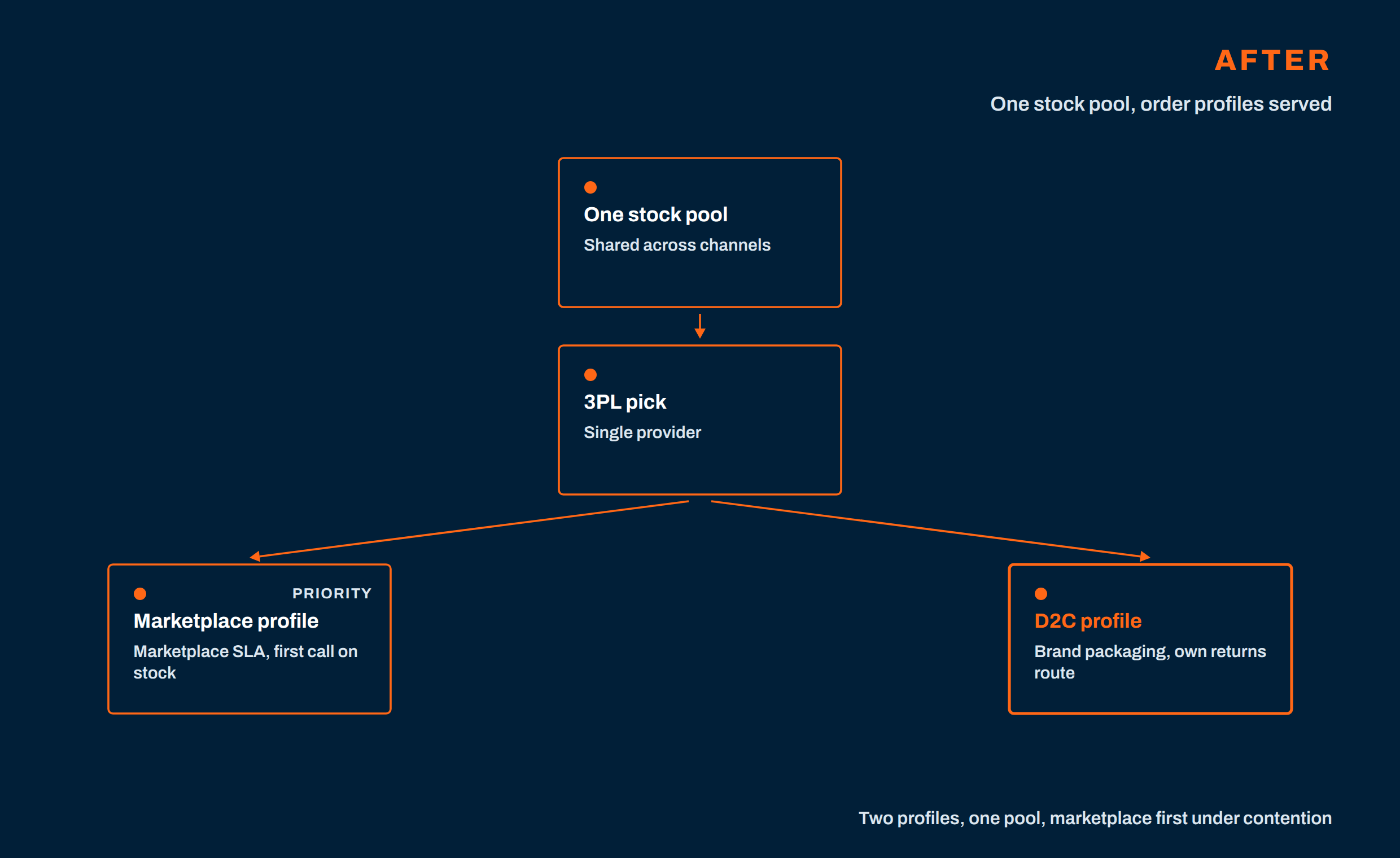
The 3PL arrangement was renegotiated to carry a second order profile: separate pick instructions, and a returns route to the brand rather than through the marketplace process. Pricing for the second profile was agreed.
Stock sits in one pool. Under contention marketplace has first call, because its SLA carries an external penalty and the brand’s own promise does not.
04
Deliver the change
Shopify was integrated to the 3PL for order intake and despatch confirmation.
The 3PL received a separate specification for the D2C profile covering packaging, pick instruction and carrier service, tested against sample orders before launch.
Launch was staged. A soft opening ran at low volume for three weeks against real orders, with despatch confirmation and returns checked end to end before any marketing drove traffic. The marketplace channel was untouched throughout.
Key Decisions & Trade-Offs
Pooled carrier rates rather than a direct contract.
At early D2C volume the brand could not earn a rate close to the one already sitting in the 3PL’s pooled book, and a worse rate on a channel built to improve margin defeats the point.
The cost is that carrier choice and branded tracking are not the brand’s to set until volume grows.
Marketplace keeps priority on stock.
Giving the new channel equal call would have protected the D2C promise. It was rejected because marketplace SLA breaches carry penalties the brand cannot absorb, while a D2C delay costs goodwill the brand can manage directly.
D2C carries the availability risk, and the storefront was built to show accurate stock rather than to promise what might not be there.
Repeat purchase built on the storefront, not a subscription programme.
Subscription is the strongest retention lever in a high-repeat consumables category, and it was deliberately held back from launch. It was deferred because subscription adds billing, cadence and churn management to a channel with no operating history, and the storefront needed a track record before that complexity was worth taking on.
The launch captures the customer record and consent that make subscription viable later, at the cost of leaving that lever unused until the channel is proven.
The Outcomes
Channel Of Their Own
The brand now sells through a storefront it controls, alongside the untouched marketplace.
First-Party Data
Every D2C order captures a consented customer record, feeding repeat purchase the brand can now prompt directly.
Two Profiles, One 3PL
The existing provider now ships brand-packaged D2C orders and marketplace orders from a single stock pool.
Pooled Rates
D2C ships at a carrier rate the channel’s own volume could not have earned.
Returns To The Brand
D2C returns route back to the business rather than through the marketplace process, with reason data captured at source.
The Handover
The client owns the Shopify storefront and its configuration, the D2C order profile at the 3PL, and the renegotiated commercial terms covering both channels.
EQ50 DIGITAL handed over the integration documentation, the D2C fulfilment specification, and the volume thresholds at which a direct carrier contract and a branded tracking experience become worth revisiting.